Abstract
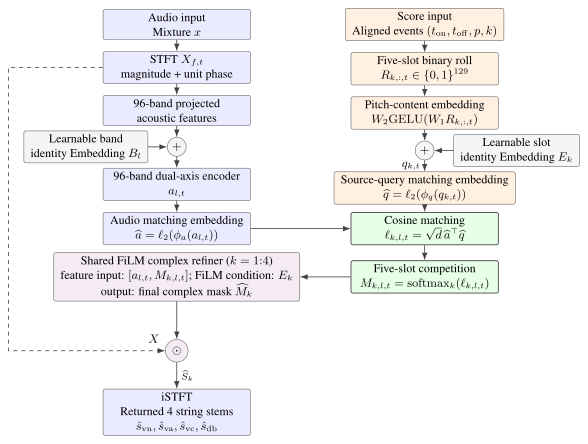
Orchestral separation recovers instrument sections from mixtures in which shared pitches, harmonics, and timbres obscure source identity. An aligned score provides instrument labels, note pitches, and activity times. A score-informed approach appends piano rolls to audio features before mask prediction. We introduce SCISSOR (Score-Conditioned Instrument Source Separation for Orchestral Recordings), which uses the score to form a frame-wise query for each source. Each query matches a shared audio representation, and a softmax over instrument and background slots jointly assigns overlapping time–frequency evidence. The queries retain instrument identity even when notes are missing from the score.
After training on SynthSOD and a small set of URMP and PHENICX-Anechoic recordings, SCISSOR achieves the highest average SDR on held-out real recordings. With SynthSOD-only training, it leads on SynthSOD and zero-shot PHENICX-Anechoic, and improves on its audio-only control on zero-shot URMP. SCISSOR also degrades less under score corruption than the evaluated score-based baselines.